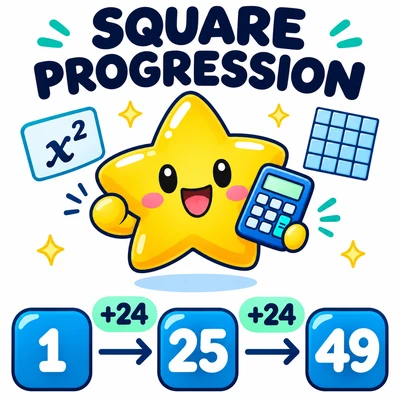
Enter two integers, m and n, between −1,000 and 1,000. The calculator generates signed integer bases a, b and c whose squares form an arithmetic progression: b² − a² = c² − b². The defaults m = 2 and n = 1 produce 1, 25 and 49, with common difference 24.
Write u = m² − n² and v = 2mn. Then a = u − v and c = u + v, so a² + c² = 2(u² + v²). Expanding gives u² + v² = (m² + n²)² = b². Therefore a² + c² = 2b², which is exactly the condition for the three squares to be in arithmetic progression.
For the common difference, factor b² − a² = (b − a)(b + a). Here b − a = 2n(m + n) and b + a = 2m(m − n), giving d = 4mn(m² − n²).
| m | n | Signed bases (a, b, c) | Squares (a², b², c²) | Common difference |
|---|---|---|---|---|
| 2 | 1 | −1, 5, 7 | 1, 25, 49 | 24 |
| 3 | 1 | 2, 10, 14 | 4, 100, 196 | 96 |
| 3 | 2 | −7, 13, 17 | 49, 169, 289 | 120 |
| 1 | 2 | −7, 5, 1 | 49, 25, 1 | −24 |
| 1 | 1 | −2, 2, 2 | 4, 4, 4 | 0 |
| 0 | 0 | 0, 0, 0 | 0, 0, 0 | 0 |
Choose m > n > 0 for an increasing, nonconstant progression. Other integer choices are also valid: a negative common difference gives a decreasing progression, and zero gives three equal squares. The difference is zero precisely when m = 0, n = 0, m = n or m = −n.
The displayed bases a and c can be negative; their squares are still nonnegative perfect squares. The calculator preserves the formula’s order rather than sorting the terms. It does not reduce common factors or claim that each parameter pair produces a distinct progression.
Use whole numbers only. The inputs use a step of 1 and bounds of −1,000 to 1,000. Within those bounds, all integer intermediate values and squared outputs stay below the exact-integer limit of ordinary double-precision arithmetic. Outputs are displayed with no decimal places; decimal inputs are outside this tool’s intended use and rounded output would not establish an integer solution.
An unavailable result indicates a calculation or input problem and must not be interpreted as zero.
Are the bases themselves in arithmetic progression?
Not necessarily. The equal-spacing condition applies to a², b² and c². For example, the default bases −1, 5 and 7 give the equally spaced squares 1, 25 and 49.
Does the calculator find parameters for a supplied progression?
No. It generates a progression from m and n. It does not solve the inverse problem or search all possible progressions.
What happens if I multiply both parameters by the same integer?
Multiplying m and n by k multiplies each base by k². Each squared term and the common difference are multiplied by k⁴. Keep the new parameters within the input bounds.
Draft production note: no registered thumbnail asset was supplied. Create and register a 400 × 400 pixel WebP thumbnail before activation, then insert it as the first image block and remove this note. Match neighboring thumbnails using a cheerful yellow five-point star mascot with hands, no separate legs or feet, a white background and playful navy, blue and teal educational graphics illustrating 1, 25 and 49 with equal gaps of 24.