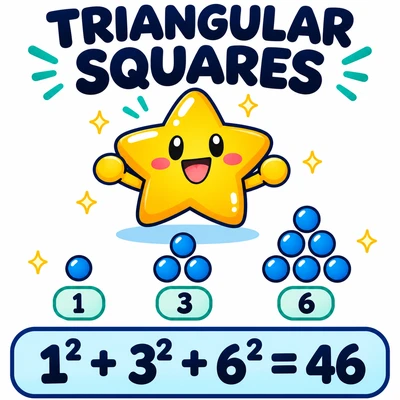
Calculate T₁² + T₂² + … + Tₙ², where Tₖ = k(k + 1)/2 is the kth triangular number. Enter a whole number n from 0 to 1,000. The calculator squares each triangular number before summing.
The triangular numbers begin 1, 3, 6, 10, 15. Their squares are 1, 9, 36, 100, 225.
For n = 5, the sum is 1 + 9 + 36 + 100 + 225 = 371. The formula gives the same result: 5 × 6 × 7 × 106 ÷ 60 = 371.
To verify the formula, call its right-hand side F(n). It satisfies F(0) = 0 and F(n) − F(n − 1) = n²(n + 1)²/4 = Tₙ². Adding these successive differences gives the required sum.
| n | Tₙ | T₁² + T₂² + … + Tₙ² |
|---|---|---|
| 0 | 0 | 0 |
| 1 | 1 | 1 |
| 2 | 3 | 10 |
| 3 | 6 | 46 |
| 4 | 10 | 146 |
| 5 | 15 | 371 |
| 10 | 55 | 7,942 |
Use whole-number values of n only. At n = 0, the empty sum is 0. Negative and fractional values do not represent a count of triangular numbers.
Keep the formula constants at their displayed values. The upper limit of 1,000 keeps the integer intermediate products below 2⁵³, the consecutive-integer precision boundary for standard double-precision arithmetic. An unavailable result is not zero; check the inputs if no result is displayed.
Is this the square of the sum of triangular numbers?
No. This calculator squares each term and then adds the squares. For n = 2, it returns 1² + 3² = 10. Squaring the sum would give (1 + 3)² = 16.
Does n mean the final triangular number or the number of terms?
n is the number of terms. For n = 5, the final triangular number is T₅ = 15, and the sum of the five squared terms is 371.
Thumbnail image creation is required: no registered thumbnail asset was supplied. Create and register a 400 × 400 pixel WebP featuring the cheerful yellow five-point star mascot with hands, no separate legs or feet, a white background, and navy, blue and teal triangular-number graphics. Inspect neighboring thumbnails before creation, then insert the registered asset as the first image block. Renderer integration and functional QA remain required before activation.