Enter an integer index n to calculate n(n+1), the product of two consecutive integers. For the usual sequence, use a nonnegative index: n = 0, 1, 2, 3, … gives 0, 2, 6, 12, …. Negative integer inputs evaluate the same formula and repeat values from the nonnegative sequence.
Enter a whole-number index between −1,000,000 and 1,000,000. The increment is fixed at 1 so the factors remain consecutive. Read the product and the next integer in the results.
Use integer inputs only. The step is set to 1; fractional inputs do not represent integer indices and rounded output should not be interpreted as a pronic number. The input bounds keep integer products within the exact-integer range of standard numeric arithmetic. An unavailable result indicates a calculation or input problem, not a result of zero.
| Index n | Calculation | Pronic number |
|---|---|---|
| 0 | 0 × 1 | 0 |
| 1 | 1 × 2 | 2 |
| 2 | 2 × 3 | 6 |
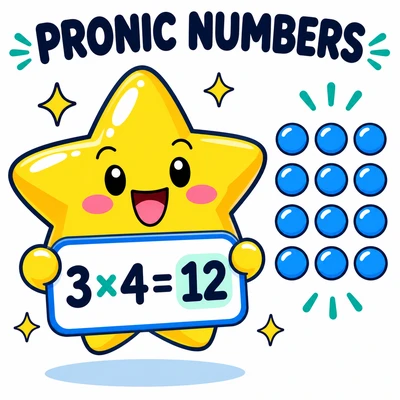
| 3 | 3 × 4 | 12 |
| 4 | 4 × 5 | 20 |
| 5 | 5 × 6 | 30 |
| 10 | 10 × 11 | 110 |
| -6 | (−6) × (−5) | 30 |
For a positive index, arrange objects in a rectangle with n rows and n+1 columns. The number of objects is n(n+1). For example, 5 rows of 6 objects contain 30 objects.
Every pronic number is even because one of two consecutive integers is even. Also, n(n+1) is twice the triangular number n(n+1)/2. From index n to n+1, the increase is 2(n+1): the first increases are 2, 4, 6 and 8.
Does the sequence start at zero or two?
This calculator uses zero-based indexing: P₀ = 0. If you list only positive pronic numbers, the sequence starts at P₁ = 2.
What happens with a negative index?
Negative integer indices repeat the same nonnegative products. The indices n and −n−1 give equal results because (−n−1)(−n) = n(n+1). For example, n = −6 and n = 5 both give 30.
Does this calculator test whether a supplied number is pronic?
The input is an index, not a candidate result. Entering 30 calculates 30 × 31 = 930. To obtain the pronic number 30, enter the index 5.